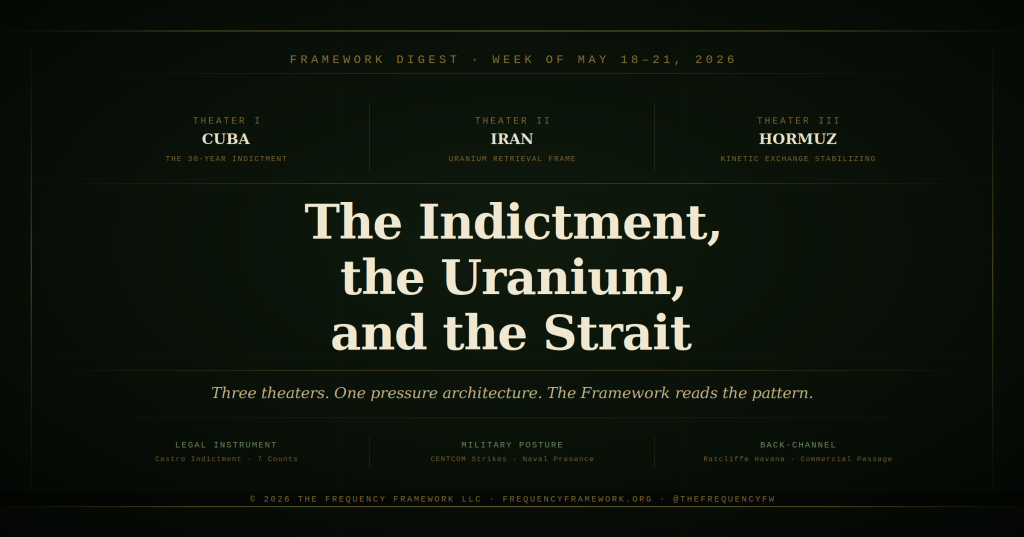
Framework Digest · Week of May 18–21, 2026
The Indictment, the Uranium, and the Strait
Three theaters. One pressure architecture. The Framework reads the pattern.
Context
The week ending May 21, 2026 produced three simultaneous pressure events across separate theaters — Cuba, Iran, and the Strait of Hormuz. Taken individually, each reads as a standalone policy move. Viewed through the Framework’s two-law architecture, they reveal a coordinated escalation pattern with a consistent structural logic: legal instrument + military posture + back-channel negotiation running in parallel.
This is what the Law of Deception predicts. Coordinated action requires escalating energy to maintain across multiple surfaces simultaneously. The friction signatures are visible. The question is what the architecture is designed to produce.
Theater 1 · Cuba: The 30-Year Indictment
On May 20, the Department of Justice unsealed a grand jury indictment of former Cuban President Raúl Castro — 94 years old, returned April 23 — charging him with seven counts including conspiracy to kill U.S. nationals, destruction of aircraft, and four counts of murder. The charges stem from the 1996 shootdown of two civilian planes operated by Brothers to the Rescue, a Cuban-American exile organization, in international airspace. Four people were killed, three of them American citizens.
Acting Attorney General Todd Blanche announced the charges at a ceremony in Miami’s Freedom Tower — a location chosen deliberately, as it serves as a historic processing site for Cuban refugees. The timing was Cuba’s independence day as observed by exile communities.
The charges have been in development for three decades. Federal prosecutors in Miami first drafted an indictment against Castro in the 1990s. The case was never brought. The unsealing now — in the context of an active pressure campaign — is not a legal development. It is a strategic one.
Law 2 · Friction Signature
One week before the unsealing, CIA Director John Ratcliffe traveled to Cuba and met with Cuban officials, including Castro’s grandson. The legal indictment and the back-channel negotiation are running simultaneously. This is the dual-track pressure pattern: legal instrument as leverage, back-channel as the actual negotiation. The indictment is not designed to produce a trial. It is designed to produce a deal. Private/public divergence is present. Ally explanation cost is elevated — U.S. partners in Latin America are being asked to hold contradictory signals.
CBS News reported the intelligence community is simultaneously gaming out how Cuba might respond to American military action — the Venezuela precedent is the operative model. Maduro was deposed in a raid. The indictment gives the U.S. the same legal pretext for a Castro capture operation. Whether that option is intended to be exercised or simply to exist as visible leverage is the open question.
Theater 2 · Iran: The Uranium Retrieval Frame
In parallel, President Trump stated publicly that the United States will “retrieve” uranium from Iran. The specific word choice is significant. The nonproliferation framework uses language of inspection, verification, and limitation. “Retrieve” is ownership language. It asserts a U.S. claim to physical possession of Iranian nuclear material — a framing with no precedent in the public record of U.S.-Iran nuclear negotiations.
Iran’s enriched uranium stockpile — accumulated in excess of JCPOA limits after the U.S. withdrawal in 2018 — is estimated at several thousand kilograms of low-enriched uranium and a smaller quantity at higher enrichment levels. “Retrieval” as a policy objective implies forced removal, not negotiated limitation or monitored storage in-country.
Law 2 · Friction Signature
The uranium retrieval framing requires Iran to accept a position of physical surrender rather than negotiated compliance. That is a structurally different demand than any prior U.S. nuclear ask. Maintaining that position publicly while conducting back-channel talks — which the Hormuz partial reopening suggests are ongoing — requires elevated energy. Counterparty non-responsiveness is predictable: Iran cannot publicly accept retrieval language without internal political cost that exceeds what the regime can absorb.
Theater 3 · Hormuz: Kinetic Exchange Stabilizing
The Strait of Hormuz remains the physical backdrop against which both the Iran uranium demand and the broader regional posture operate. U.S. naval forces have conducted CENTCOM self-defense strikes in the Strait following kinetic exchange with Iranian assets. The Strait has not closed — commercial traffic is moving, partially under Iranian-coordinated passage protocols according to Iranian state claims — but the military presence on both sides remains elevated.
The partial stabilization of Hormuz while maximum-pressure language on uranium escalates is itself a signal. The military temperature is being managed at the operational level while the political temperature is being raised at the rhetorical level. Those two tracks are not in contradiction — they are coordinated.
The Architecture Across All Three Theaters
The Framework reads a single structural pattern operating across Cuba, Iran, and the Strait simultaneously:
| Theater | Legal Instrument | Military Posture | Back-Channel |
|---|---|---|---|
| Cuba | Castro indictment (7 counts) | Venezuela raid precedent visible | Ratcliffe in Havana, May 14 |
| Iran | Uranium “retrieval” demand | CENTCOM strikes, naval presence | Hormuz partial stabilization |
| Hormuz | Self-defense strike authority | Three named destroyers active | Commercial passage ongoing |
Each theater shows the same structure: maximum public pressure deployed as leverage while negotiation tracks run parallel. The Law of Deception predicts this pattern generates friction because it requires maintaining contradictory public and private positions simultaneously. The energy cost of that maintenance is measurable in the form of ally confusion, counterparty non-responsiveness, and the escalating specificity of the public demands — “retrieval” rather than “limitation” is an example of the ratchet effect that emerges when deception-maintenance cost rises.
Why It Matters
Running three simultaneous dual-track pressure operations — each combining legal instrument, military posture, and back-channel negotiation — is operationally expensive. The Cuba indictment, the Iran uranium demand, and the Hormuz kinetic posture are not independent events. They share an architecture.
The Law of Truth predicts that architectures requiring this level of maintenance energy eventually simplify — deals get made, postures collapse, or they escalate into action. The current trajectory has all three theaters in an elevated-but-stable holding pattern. That holding pattern has a carrying cost. Something will move.
The Framework will be watching which theater breaks first, and in which direction.
Developing · May 22, 2026 · 5PM PT
CBS News reports the Trump administration was preparing Friday for a fresh round of military strikes against Iran, per sources with direct knowledge of planning. No final decision reached as of Friday afternoon. Diplomacy continuing in parallel. Earlier Friday: DNI Tulsi Gabbard was forced out by the White House; career CIA covert operations officer Aaron Lukas installed as acting DNI. President Trump cancelled attendance at his son’s wedding, remaining at the White House for the full Memorial Day weekend citing government circumstances. The three-theater architecture outlined above is now confirmed active at the decision level. The Framework will continue monitoring.
Full synthesis & Tier 2 analysis → patreon.com/TheFrequencyFramework
Methodology → frequencyframework.org
Tools → frequencyfw.github.io/Tools


Leave a Reply